
Wednesday, June 11, 2025
July Drawing Course

Wednesday, June 4, 2025
School of Athens


Tuesday, May 13, 2025
'Friendship', the movie

Friday, October 1, 2021
Online Drawing Class in October (Tacoma Art Class) Hello, and hope this post finds you well!
I will be teaching an (online-Zoom) drawing class coming up in October.
Drawing Foundations Class
*5 week class, Weekly on Wednesdays (Starts October 13)
*Online (Zoom-please download)
*Register/Pay at https://www.timothymansen.com/workshops
*$250 for 5-week class (Early Bird Discount if paid by October 1)
*All Levels Welcome
*Rigorous, yet enjoyable class; Homework assigned each week
Please consider joining. For more info, and to register/pay, please go to the following link...
https://www.timothymansen.com/workshop/28277/drawing-foundations-fall-2021-5-week-class
Hello, and hope this post finds you well!
I will be teaching an (online-Zoom) drawing class coming up in October.
Drawing Foundations Class
*5 week class, Weekly on Wednesdays (Starts October 13)
*Online (Zoom-please download)
*Register/Pay at https://www.timothymansen.com/workshops
*$250 for 5-week class (Early Bird Discount if paid by October 1)
*All Levels Welcome
*Rigorous, yet enjoyable class; Homework assigned each week
Please consider joining. For more info, and to register/pay, please go to the following link...
https://www.timothymansen.com/workshop/28277/drawing-foundations-fall-2021-5-week-class

Friday, September 25, 2020
New Website!
Hey Everybody.
Check out my new art website, www.TimothyMansen.com
Thursday, April 23, 2020
New Online Art Lessons!
Now Offering Private Online Lessons (through Zoom):

Student working on 'Horse of Torino' cast drawing.
After years of running a small art academy (Tacoma Academy of Fine Art), along with various teaching gigs and students, I am creatively adapting to the current social distancing situation, and will be starting online art classes through Zoom. I am now taking on students for private lessons. I am excited for this new opportunity!

Student working on 'Michelangelo' cast drawing.
Lessons will be taught in 1-hour intervals
Due to the c-19 crisis, I want to make these lessons affordable, while still making an income for myself. Therefore, I will be charging on a sliding scale. $40 per hour is the base rate (this is a discounted rate off my normal fee), with discounts available to those in financial need, and increases appreciated from those who can afford it.

Drawing the live model.
Structure: I will be taking the classical atelier approach to curriculum. Beginning students focus on drawing, then progress to grayscale painting,
and finally their studies culminate with color painting (see examples below). I use this approach as a basis, although I will also consider other approaches and courses of study, per student's appeal. Duration of curriculum, goals, and meeting times will be discussed on an individual basis, with students.
To sign up, or for questions, email me at: tim.mansen@gmail.com. So contact me and let's talk about your road to creativity!
Take a look at some of my drawings and paintings...


Take a look at some of my drawings and paintings...


Tuesday, April 21, 2020
Portrait Drawing with Tony Ryder

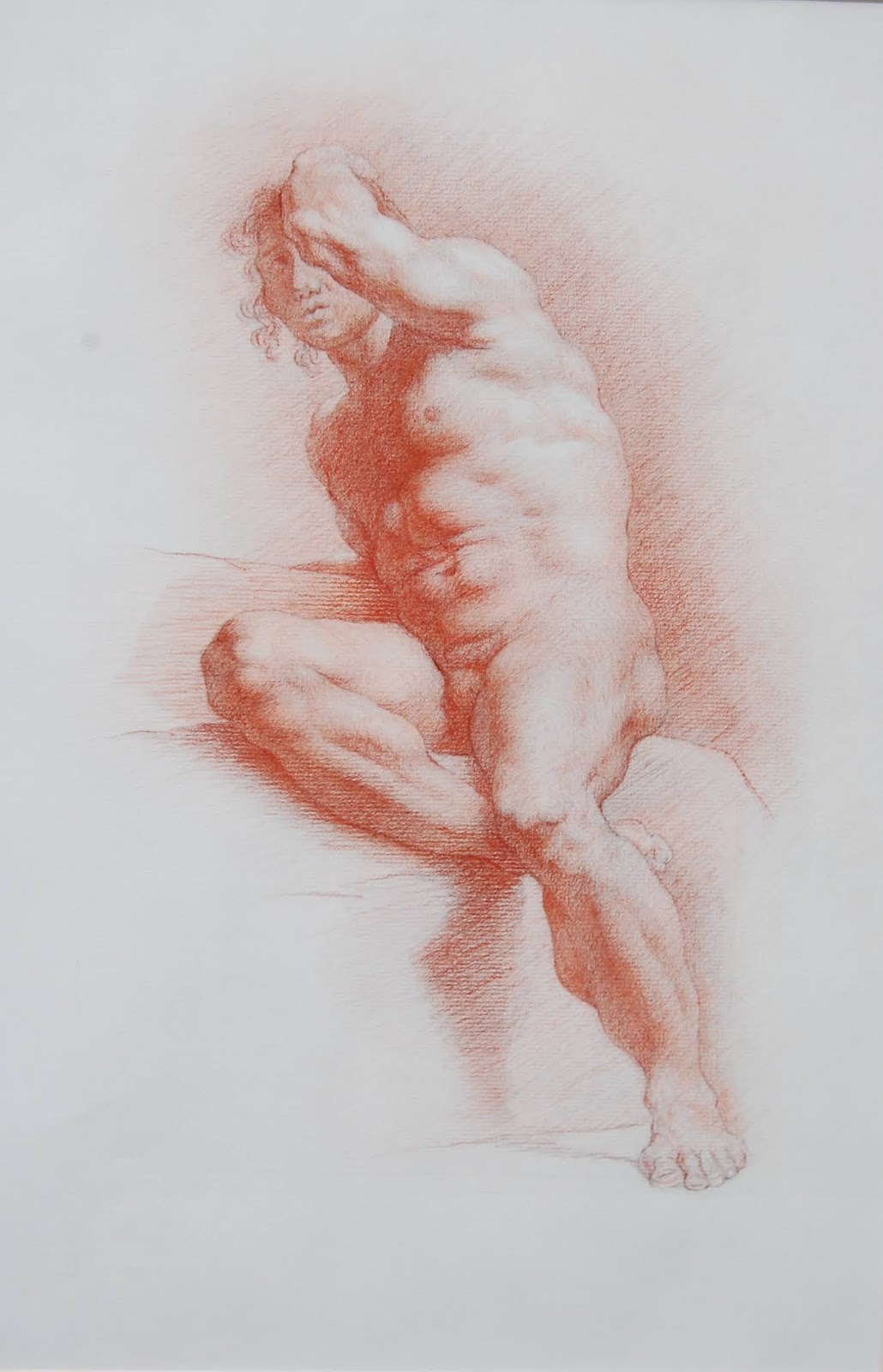
This is a drawing I did, working from a live model, in the workshop of Tony Ryder, this last December (at Gage Academy, in Seattle). This drawing took me 3 session to complete (12 hours total). Mr. Ryder is a fabulous instructor, master draftsman, funny and humble guy. I learned so much, met some great folks, and had a blast. Mr. Ryder runs an atelier (called the Ryder Studio -- https://www.theryderstudio.com/) in Santa Fe, NM, and I would love to take another class with him some day.
Saturday, April 18, 2020
Living Creativity
I really enjoy reading biographies of artists whose work that I enjoy. Creativity is so interesting and mysterious.
I have really enjoyed looking at the work of Andrew Wyeth, and through the book, 'Andrew Wyeth: Autobiography' (Konecky and Konecky Publishers), I get a glimpse into his creative process, as he shares his thoughts about many of his completed works of art. Here are a couple examples...

The painting above is called 'The Kuerners' and it features Andrew Wyeth's neighbors, Karl and Anna Kuerner. This is a painting that is stark, simple, and also strange, as many of Wyeth's are, opening a door to our own imagination and narrative. But the reason I'm using the painting as an example here is that it is representative of Andrew Wyeths' creative process.
In the book 'Andrew Wyeth: Autobiography', Wyeth describes starting this painting with just the male figure and (originally) a taxidermy moose head, hanging on the wall behind him. But, apparently being unsatisfied with the painting, he set it aside and upon finally getting back to it, after 2 years, Wyeth sandpapered out the moose head, which 'gave the most perfect texture to the wall'. Then he painted in Anna (Karl's wife) soon after, thus completing the painting.
Creativity, and paintings, in this case, have a life of their own. Rarely do artists know what to make of their work, and how their 'completion' will come about.
Another example of this is seen below...

The painting shown above is 'Christina's World', also by Andrew Wyeth. It is probably his most recognizable work. This has become an iconic American painting, recognizable to many. But interestingly, upon completion of the painting, Wyeth in disappointment described the work as a "flat tire", before sending off to a gallery. But soon it ended up in the collection of the Museum of Modern Art (MOMA), where it currently hangs.
It is difficult for artists to be objective about their own work, and whether or not they will be received. Fortunately for Wyeth, he was appreciated during his life-time, understandably as he produced timeless, beautiful work. For others, although they may produce works of great beauty, this recognition will not happen until they have passed on, if ever. Maybe the artwork will resonate with just a single person. Is that still a success?
Creativity seems to have a life of it's own. It is transmitted through, and received by, those who are open.
I have really enjoyed looking at the work of Andrew Wyeth, and through the book, 'Andrew Wyeth: Autobiography' (Konecky and Konecky Publishers), I get a glimpse into his creative process, as he shares his thoughts about many of his completed works of art. Here are a couple examples...

The painting above is called 'The Kuerners' and it features Andrew Wyeth's neighbors, Karl and Anna Kuerner. This is a painting that is stark, simple, and also strange, as many of Wyeth's are, opening a door to our own imagination and narrative. But the reason I'm using the painting as an example here is that it is representative of Andrew Wyeths' creative process.
In the book 'Andrew Wyeth: Autobiography', Wyeth describes starting this painting with just the male figure and (originally) a taxidermy moose head, hanging on the wall behind him. But, apparently being unsatisfied with the painting, he set it aside and upon finally getting back to it, after 2 years, Wyeth sandpapered out the moose head, which 'gave the most perfect texture to the wall'. Then he painted in Anna (Karl's wife) soon after, thus completing the painting.
Creativity, and paintings, in this case, have a life of their own. Rarely do artists know what to make of their work, and how their 'completion' will come about.
Another example of this is seen below...

The painting shown above is 'Christina's World', also by Andrew Wyeth. It is probably his most recognizable work. This has become an iconic American painting, recognizable to many. But interestingly, upon completion of the painting, Wyeth in disappointment described the work as a "flat tire", before sending off to a gallery. But soon it ended up in the collection of the Museum of Modern Art (MOMA), where it currently hangs.
It is difficult for artists to be objective about their own work, and whether or not they will be received. Fortunately for Wyeth, he was appreciated during his life-time, understandably as he produced timeless, beautiful work. For others, although they may produce works of great beauty, this recognition will not happen until they have passed on, if ever. Maybe the artwork will resonate with just a single person. Is that still a success?
Creativity seems to have a life of it's own. It is transmitted through, and received by, those who are open.
Saturday, April 11, 2020
After Rembrandt

I just came across some oil-painting studies I have done over the last few years. Here is a study I did after a Rembrandt self-portrait (see above). I like the loose approach I took with it. I think Rembrandt was just 23 when he painted the original. Beautiful work, but much more tight and polished than his later work, which was maybe riskier and more 'painterly'.
Here (below) is the original painting, by Rembrandt...

And here is a later Rembrandt self portrait (below)...

Friday, April 10, 2020
Plein Air Painting - Purdy

Painted at the Purdy spit. I am glad that even during the times of Coronavirus we can get outside and be creative.
Saturday, February 29, 2020
Value, Light and Form
Value, Light and Form
This past Wednesday we talked about value, light and form. And we applied this knowledge as we started the shading process.

This value scale (seen above) is the palette we use for shading. This scale is broken down into 5 values.

Here we are applying our value scale to what we are learning about light hitting form, in this case a sphere. (Notice that every transition of value on the sphere is assigned a number from the value scale. Also note that the value scale here is broken down into 9 tones, compared to our 5. There are an infinite number of values in the visible world, but we break them down to make them manageable).

Here is the sphere I started to demo during class.
Homework: Continue shading your Bargue plate, and if time allows try your hand at the sphere drawing, presented in our text book, 'Beginning Drawing Atelier'.
This past Wednesday we talked about value, light and form. And we applied this knowledge as we started the shading process.

This value scale (seen above) is the palette we use for shading. This scale is broken down into 5 values.

Here we are applying our value scale to what we are learning about light hitting form, in this case a sphere. (Notice that every transition of value on the sphere is assigned a number from the value scale. Also note that the value scale here is broken down into 9 tones, compared to our 5. There are an infinite number of values in the visible world, but we break them down to make them manageable).

Here is the sphere I started to demo during class.
Homework: Continue shading your Bargue plate, and if time allows try your hand at the sphere drawing, presented in our text book, 'Beginning Drawing Atelier'.
Friday, February 21, 2020
Bargue Plates
Bargue Plates:
This past week in class we discussed 'Volume' and introduced light and shade into the discussion. Then we looked at some 'Bargue Plates', and saw how light and shadow 'planes' are demonstrated in a drawing.

This is my demonstration of how to 'Block-In' a drawing, using a Bargue Plate as a reference. The image above reflects the first stage of the drawing.

In the image above, I have carried the drawing to the next stage, which is 'massing-in the shadow shapes', with a light veil of tone (just enough contrast to differentiate light from shadow). Note that this is the intermediary stage between the 'Block-In' and the 'Shading'. By massing in the shadows, we are setting the stage for the shading process. For your homework, bring your drawing to the level of the stage indicated above. Next week we will further discuss light and shadow, tone, and then start shading.
For fun, check out this finished Bargue plate, drawn by a young Pablo Picasso...

This past week in class we discussed 'Volume' and introduced light and shade into the discussion. Then we looked at some 'Bargue Plates', and saw how light and shadow 'planes' are demonstrated in a drawing.

This is my demonstration of how to 'Block-In' a drawing, using a Bargue Plate as a reference. The image above reflects the first stage of the drawing.

In the image above, I have carried the drawing to the next stage, which is 'massing-in the shadow shapes', with a light veil of tone (just enough contrast to differentiate light from shadow). Note that this is the intermediary stage between the 'Block-In' and the 'Shading'. By massing in the shadows, we are setting the stage for the shading process. For your homework, bring your drawing to the level of the stage indicated above. Next week we will further discuss light and shadow, tone, and then start shading.
For fun, check out this finished Bargue plate, drawn by a young Pablo Picasso...

Friday, February 7, 2020
Block-In Drawing Demo
Here is a demo I did for the 'Drawing: A Visual Language' class, at Alma Mater. The drawing is a 'master-copy' of a beautiful drawing by Leonardo Da Vinci.

And here is my 'block-in' drawing, after the original Da Vinci drawing...

The stage shown (above) is first step of the block-in. Notice that I am not focusing on detail or features, but rather I am thinking of the most general relationships. Here are the steps of logic that I've taken to get to this point:
-Consider the vertical Top, Bottom, and Middle of the drawing.
-Start Blocking-In the major directional lines / angles.
-I am keeping my lines straight, light.
-I am carrying my lines through. Notice the line of the neck does not end at the neck, but extends upward. In this way, I am focusing on big relationships / connections. Remember the principle of *UNITY*.
-Don't let the construction lines dominate the drawing. They should be lighter than the block-in lines.
-Once you have drawn out the contour, measure (using a long pencil, skewer, or knitting needle) the width against the height.

The stage shown (above) is the more advanced stage of the block-in. Remember, this is still a primary stage of the drawing. In this stage, I have broken down the big general lines into more specific contours. I have also started to consider the shadow shapes on the inside of the head.
If all of this is overwhelming, take heart. It is a lot, at first. But it is worth it, as these stages will help you to draw well. We will review these concepts this next week.

And here is my 'block-in' drawing, after the original Da Vinci drawing...

The stage shown (above) is first step of the block-in. Notice that I am not focusing on detail or features, but rather I am thinking of the most general relationships. Here are the steps of logic that I've taken to get to this point:
-Consider the vertical Top, Bottom, and Middle of the drawing.
-Start Blocking-In the major directional lines / angles.
-I am keeping my lines straight, light.
-I am carrying my lines through. Notice the line of the neck does not end at the neck, but extends upward. In this way, I am focusing on big relationships / connections. Remember the principle of *UNITY*.
-Don't let the construction lines dominate the drawing. They should be lighter than the block-in lines.
-Once you have drawn out the contour, measure (using a long pencil, skewer, or knitting needle) the width against the height.

The stage shown (above) is the more advanced stage of the block-in. Remember, this is still a primary stage of the drawing. In this stage, I have broken down the big general lines into more specific contours. I have also started to consider the shadow shapes on the inside of the head.
If all of this is overwhelming, take heart. It is a lot, at first. But it is worth it, as these stages will help you to draw well. We will review these concepts this next week.
Monday, February 3, 2020
Portrait of Ron

Friday, November 15, 2019
The Tone Scale
Mixing a Tone Scale:
For next week, please have a tone scale mixed, ready to bring to class, 5 tones. Along with enough paint to apply over your under-painting. Remember that #1 and #5 don't need to be mixed, as they are already tubed for you (#1 is WHITE, and #5 is BLACK). So you will need to mix #2, #3, and #4.
To begin, you will need the following supplies (and paper towels / rags):


For next week, please have a tone scale mixed, ready to bring to class, 5 tones. Along with enough paint to apply over your under-painting. Remember that #1 and #5 don't need to be mixed, as they are already tubed for you (#1 is WHITE, and #5 is BLACK). So you will need to mix #2, #3, and #4.
To begin, you will need the following supplies (and paper towels / rags):

Start by placing #1 (White) and #5 (Black) on your smooth mixing surface. Use a goodly portion of paint. You will need enough for both your scale, as well as for Wednesday class, to begin painting.

Mix #1 and #5 with your palette knife to create your mid-tone (#3).

Mix your #1 and #3 to create your #2 tone.

Mix #5 and #3 to create your #4 tone. You now have your 5-tones

Lay your tones side by side in a uniform fashion. This is your tone scale (My scale, seen below, indicates 9 tones, but you only have to build 5, unless you want to be extra ambitious)!


Bring your tone scale to class Wednesday, as well as your 5 tones of paint, all mixed and ready to apply to your painting (If you finish mixing your tones days before class, preserve your paints by putting them in your 'Seal-A-Kit', pop the lid on, and put it in the freezer, until you leave for class. They will thaw by the time you arrive).

This is what your painting will look like on Wednesday. Note the brown under-painting, covered with the tonal 'over-painting'...

Friday, October 25, 2019
Painting Class in November

Atalanta and
Hippomenes’, by Guido Reni
TONE DESIGN
In Oil Paint
5
week class
Instructed
by Tim Mansen
Wednesdays,
Nov. 6–Dec. 4
At:
Alma Mater, the Hive
6:00 – 8:30; $225
6:00 – 8:30; $225
Learn the elements of picture making, through the tradition of master-copying, from artwork featured in
the ‘Flesh and Blood’ show at SAM. To Register, contact Tim Mansen (tim.mansen@gmail.com)


Poster study by Tim Mansen
Hobo Heaven

Purdy Shore
Big Drift

Saturday, March 18, 2017
Still Life, Oil Study
Recent Still Life Study, 'For Renee',
Oil on Canvas
 |
| Initial 'Block-In' |
 |
| Finished Painting |
the opportunity to explore composition, color harmony, and mood. Also enjoying the works of some of the past masters of still life: Fantin LaTour, Chardin, and Abbot Thayer.
Subscribe to:
Posts (Atom)